Category: Headlights

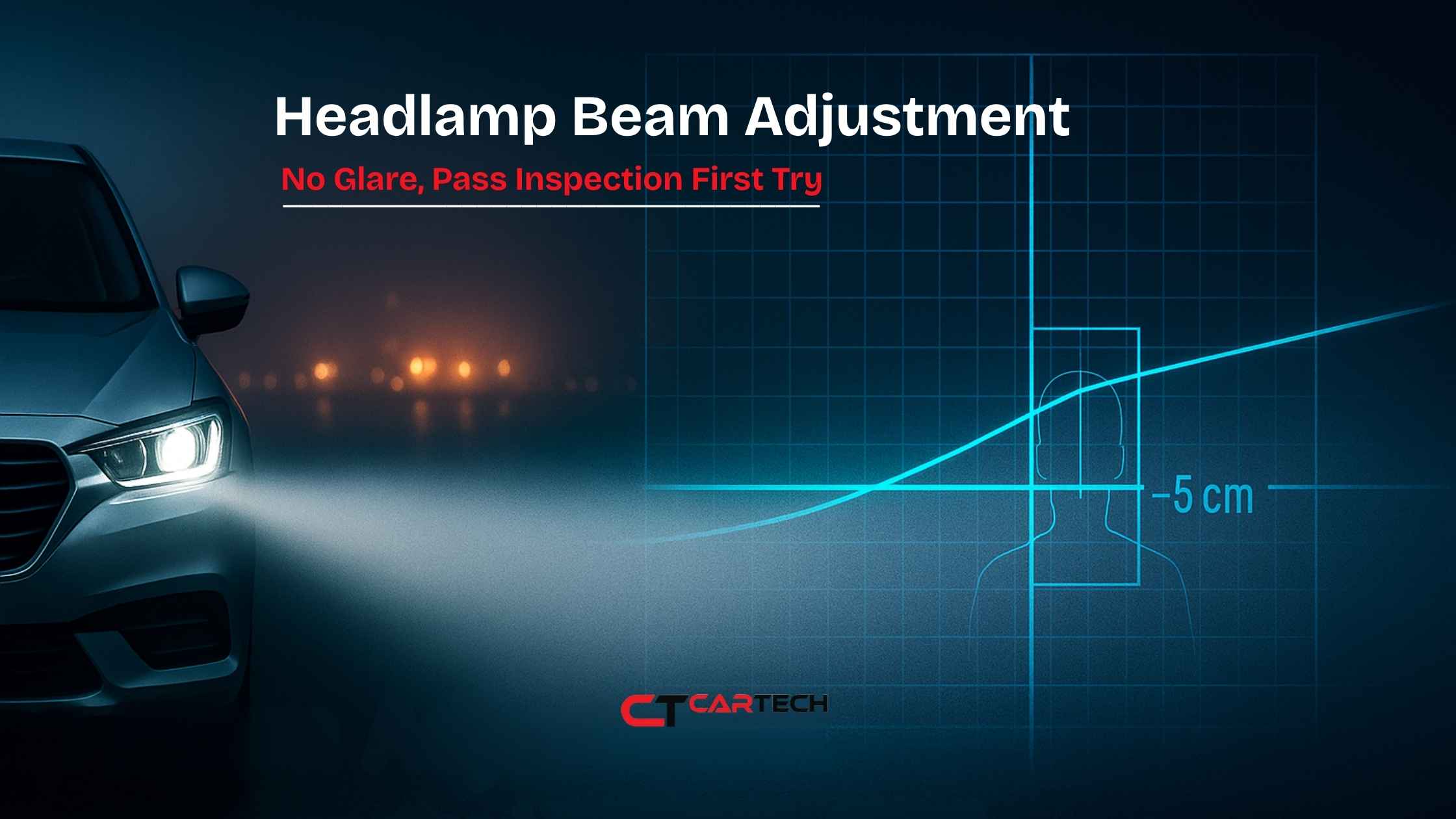
  • Headlamp Beam Adjustment: No Glare, Pass Inspection First Try

    Headlamp Beam Adjustment: No Glare, Pass Inspection First Try

    The night fog rolls in thick and fast off Keelung Harbor, blurring the lines between the sea and the sky. An oncoming car crests a slight rise, its headlights hitting you like a physical force—a blinding, blue-white glare that momentarily erases the road ahead. It’s a terrifying split second that every driver in Taiwan has experienced. This is precisely why a proper headlamp beam adjustment isn’t just a task on a maintenance checklist; it’s a fundamental responsibility for anyone who gets behind the wheel.

    As a former vehicle inspection officer, I’ve seen it all. I’ve seen brand new cars fail because of poorly aimed lights and old beaters pass with flying colors because the owner took ten minutes to get it right. Here at CarTech, we want to empower you with that same knowledge. This guide will walk you through the process, step-by-step, so you can achieve a perfect, safe beam pattern that cuts through the dark without dazzling others and helps you pass your vehicle inspection on the very first try.

    Why Proper Beam Adjustment Is Non-Negotiable

    Let’s be clear: this is about more than just avoiding a ticket. Misaligned headlights are a serious safety hazard.

    • If they’re aimed too low, your visibility is drastically reduced. You won’t see a pedestrian, a stray dog, or a pothole until it’s too late. Your effective stopping distance becomes dangerously short.
    • If they’re aimed too high, you create dangerous glare for oncoming drivers, temporarily blinding them. Studies have shown that properly aimed headlights can reduce nighttime accidents involving pedestrians by a significant margin.

    In Taiwan, incorrect headlight aim is one of the top reasons for failing the annual inspection, leading to re-test fees and wasted time. Getting it right saves you money, time, and could even save a life.

    Your Tools & Prep Checklist

    You don’t need a high-tech workshop to do this, but you do need the proper setup. Precision is key.

    • A flat, vertical wall (such as a garage door or building side) is perfect.
    • At least 10 meters of level ground in front of the wall.
    • Measuring Tape: To measure distances and heights accurately.
    • Masking Tape: To mark your guidelines on the wall.
    • A Bubble Level: To ensure your reference lines are perfectly horizontal.
    • The Right Tool: A Phillips screwdriver, a hex driver (often 7mm), or a Torx driver, depending on your vehicle’s adjuster screws.
    • For Pro Results: A dedicated headlight alignment board (調整板) from CarTech.tw can make the process faster and more precise.

    Before you start, prepare your vehicle. Ensure your tire pressures are correct, the fuel tank is at least half full, and have someone of average driver weight sit in the driver’s seat. This mimics real-world driving conditions.

    Understanding Beam Anatomy: The Art of the Cut-Off

    To adjust a beam, you must first understand its shape. The most important feature of your low beam is the beam cut-off (切線). This is the sharp line at the top of the pattern that separates the light from the dark.

    For Left-Hand Drive (LHD) vehicles like we have in Taiwan, the cut-off line has a specific shape:

    • It’s flat on the left side. This prevents your light from shining into the eyes of oncoming drivers.
    • It has a 15-degree “kick-up” to the right. This upsweep illuminates the right side of the road, lighting up road signs and the shoulder where pedestrians or cyclists might be.

    This precise 車燈 光型 調整 (chē dēng guāng xíng tiáo zhěng – car light beam pattern adjustment) is critical. Using a right-hand drive beam assembly from a country like Japan or the UK would be incredibly dangerous here, as the kick-up would be on the left, directly blinding oncoming traffic.

    The Definitive DIY Headlamp Beam Adjustment Procedure

    Follow these steps meticulously for a perfect result.

    1. Position Your Vehicle: Park on your level ground, with the front of your headlights exactly 7.6 meters (that’s 25 feet) from your flat wall. Make sure the car is parked perfectly perpendicular to the wall.
    2. Settle the Suspension: Gently push down on each corner of the car a few times and let it settle for 30 seconds. This ensures the vehicle is at its proper, natural ride height.
    3. Find Your Centerlines:
      • Measure the distance from the ground to the exact center of each headlight lens. They should be the same height.
      • Use masking tape to create two vertical lines on the wall, marking the center point of each headlight.
    4. Mark the Horizontal Line: Using your bubble level, run a horizontal strip of masking tape on the wall that connects your two vertical lines at the exact height you measured in the previous step. This is your “Headlight Centerline.”
    5. Create the Target Line: This is the most crucial step. Measure 5 cm (about 2 inches) down from the Headlight Centerline and run another horizontal strip of tape. This lower line is your target for the beam’s cut-off.
    6. Adjust One Light at a Time: Cover one headlight with a thick towel or piece of cardboard. Turn on your low beams. The beam from the uncovered headlight should now be projected onto the wall.

    Fine-Tuning with the Headlight Leveling Screw

    Now for the adjustment itself. On the back of the headlamp assembly, you’ll find the adjuster screws. There are usually two: one for vertical (up/down) aim and one for horizontal (left/right) aim.

    • Using the correct tool, turn the vertical headlight leveling screw in small, quarter-turn increments. Feel the subtle click each detent offers—this helps you keep track of your adjustments.
    • Your goal is to align the flat part of the beam’s cut-off perfectly with the lower horizontal tape line on the wall.
    • The “kick-up” to the right should begin right at the vertical tape line that marks the headlight’s center.
    • Once the first light is perfect, cover it and repeat the same process for the other headlight.

    Common Mistakes and Instant Fixes

    • Sloppy Beam Pattern: If your cut-off line is blurry or indistinct, your bulb is likely not seated correctly in the housing. This is a prevalent issue after installing aftermarket LED bulbs without care. The solution is to remove the bulb and reinstall it, ensuring it locks into place perfectly. Poorly designed LEDs can also have this issue due to bad chip placement, which is why a quality assembly with good LED headlight heat dissipation is crucial.
    • Suspension Changes: If you’ve installed a lift kit, lowering springs, or even just carry heavy loads frequently, you MUST perform a headlamp beam adjustment. Changing the vehicle’s rake angle by even a couple of degrees can throw your aim off dramatically.
    • Forcing the Screw: The adjuster mechanisms are often made of plastic. If a screw feels seized, don’t force it. A small spray of lubricating fluid might help, but if it’s broken, the entire assembly may need replacement.

    Quick-Reference Aiming Drop Table

    While 5 cm is a great general rule, different vehicle types have slightly different ideal drops.

    Vehicle TypeRecommended Drop at 7.6mInspector Tolerance
    Sedan / Hatchback5.0 cm± 1.0 cm
    SUV / Crossover6.0 cm± 1.0 cm
    Light Truck / Van7.0 cm± 1.0 cm

    The Post-Adjustment Road Test

    The wall gives you the data, but the road gives you the proof. Take a drive on a quiet, dark road.

    • The cut-off should be visible and crisp, painting a precise ribbon of light across the road.
    • It should feel like you have excellent visibility for at least 60-80 meters ahead of you.
    • When a car approaches, your lights should not be hitting their windshield or side mirrors. This is the ultimate test to avoid headlight glare.

    Your Headlamp Inspection Checklist for Success

    On the day of your inspection, a little prep goes a long way.

    • Wipe your headlight lenses clean. A dirty lens can diffuse the beam and cause a failure.
    • Confirm all lights work—low beam, high beam, indicators, and parkers.
    • If you have a manual leveling dial inside your car (often numbered 0-3), make sure it is set to “0” for an unloaded vehicle.
    • Arrive with confidence, knowing you’ve done the job right.

    Conclusion

    Back in Keelung, a car with perfectly aimed headlights approaches. Its beam slices cleanly through the fog below your line of sight, illuminating the road for the driver without ever compromising your vision. A moment later, it’s gone, and you continue on your way safely. This is the standard we should all aim for. By mastering a proper headlamp beam adjustment, you’re not just preparing to pass an inspection. You’re becoming a safer, more courteous, and more responsible member of Taiwan’s driving community.

    Do you need the right tools for the job? Order our professional headlight alignment boards and bubble levels today. Or, if your assemblies are old and faded, explore our range of OEM-spec replacements like the brilliant LED Headlamp Assembly for the Vios 2018.

    Because the right light guides you—and everyone else—home.

    FAQs: Headlamp Beam Adjustment

    1. How far from the wall should I park my car for alignment?

    The industry standard is 7.6 meters, or 25 feet. Parking closer or farther away will change the geometry and result in an incorrect aim. Consistency is key.

    2. Do LED retrofit bulbs change the headlight aim?

    They shouldn’t change the aim if they are well-designed and installed correctly, but you should ALWAYS check your alignment after swapping bulb types. The physical position of the light-emitting source on the bulb is critical, and even a millimeter of difference can alter the beam pattern.

    3. What if my adjuster screw is seized or just keeps spinning?

    If a screw is seized, try a penetrating lubricant. If it spins freely without changing the aim, the internal mechanism is likely stripped or broken. Unfortunately, this usually requires replacing the entire headlamp assembly.

    4. Does putting heavy cargo in my trunk alter the beam height?

    Yes, absolutely. Heavy cargo in the trunk will squat the rear suspension and raise the front, causing your headlights to aim higher and create glare. This is why many modern cars have an auto-leveling system or a manual adjustment dial on the dashboard to compensate when carrying loads.

    Key Takeaways

    • Safety: Proper aim is your first line of defense in nighttime driving, allowing you to see hazards without blinding other drivers.
    • Compliance: A precise headlamp beam adjustment is one of the easiest ways to ensure you pass Taiwan’s annual vehicle inspection on the first try.
    • Coming up to your lights correctly is a fundamental act of respect for every other driver sharing the road with you.
    • Precision: Use the 7.6-meter distance, a level surface, and the 5 cm drop method for accurate, repeatable results every time.
  • LED Headlight Heat Dissipation: Aluminum Fins vs Fans

    LED Headlight Heat Dissipation: Aluminum Fins vs Fans

    The Taipei night air is thick enough to drink, a humid cocktail of scooter exhaust and the aroma of stinky tofu from a nearby night market. A river of red taillights flows down Zhongxiao East Road. Your headlights cut through the haze, two beams of brilliant, clean white light. Inside each of those modern marvels is a tiny sun—an LED chip no bigger than your pinky nail, blazing with intensity. But like any star, this tiny sun generates immense heat. Taming that heat is the single most critical factor in modern lighting design. Without effective LED headlight heat dissipation, that brilliance will fade, and the tiny sun will burn itself out far too soon.

    At CarTech.tw, we live and breathe this challenge. We understand that for our professional partners—the workshops, parts buyers, and serious DIYers who are the backbone of Taiwan’s automotive scene—a headlight isn’t just a part. It’s a promise of safety, performance, and reliability. This article dives deep into the heart of the matter: the two rival technologies battling to keep that promise. In one corner, we have the silent, stoic, passive aluminum fin. In the other, the energetic, high-performance active micro-fan. It’s a classic engineering face-off, and choosing the winner depends entirely on your specific needs.

    Why LED Headlight Heat Dissipation Matters

    An LED isn’t like an old halogen bulb, which loves to run hot. LEDs are semiconductors, and they are sensitive to temperature. While they convert a good portion of energy into light, the rest becomes heat, right at the chip. If that heat isn’t drawn away efficiently, the consequences are severe:

    • Reduced Lifespan: It’s a brutal rule of thumb in semiconductor physics: for every 10°C increase in an LED’s operating temperature, its useful life can be cut by as much as 30-50%. An LED rated for tens of thousands of hours could fail in a fraction of that time without proper cooling.
    • Decreased Lumen Output (Light Decay): As an LED chip gets hotter, its efficiency drops. The light it produces becomes dimmer, a phenomenon known as lumen depreciation. This isn’t just a minor annoyance; it’s a safety issue.
    • Color Shift: Extreme heat can degrade the phosphor coating on white LEDs, causing the crisp, white light to shift towards a cooler, bluer, and less effective hue.
    • Component Failure: It’s not just the LED chip at risk. The driver, circuitry, and other electronic components within the bulb assembly can be damaged or destroyed by excessive heat, leading to complete failure.

    The stakes are high. Headlight failures are a significant safety concern, and effective thermal management is the first line of defense.

    How Passive Aluminum Fins Work

    Think of passive cooling as the strong, silent type. It relies on fundamental physics—conduction and convection—to move heat away from the LED chip. The primary component here is the heat sink (散熱片), a meticulously designed piece of metal that acts like a superhighway for thermal energy.

    Material Science—6063-T5 Alloy Explained

    Not all aluminum is created equal. While many manufacturers use standard 6061 aluminum, we at CarTech have standardized on 6063-T5 alloy for our passive heat sinks. The reason is simple: it has vastly superior thermal properties. This specific alloy can pull heat away from the LED chip much more effectively than common 6061 aluminum, a critical advantage that translates directly into better performance and longevity. Furthermore, 6063 is excellent for extrusion, allowing us to create more complex and efficient fin designs.

    Fin Geometry (Surface Area, Spacing, and CFD Insights)

    The goal of a heat sink is to maximize its surface area to dissipate heat into the surrounding air. This is where geometry becomes critical.

    • Surface Area: More fins and deeper fins mean more surface area.
    • Spacing: The fins can’t be too close together, or they will trap a boundary layer of hot air, choking off convection.
    • Airflow: The design must account for natural air movement within the headlight housing.

    In our lab, we use Computational Fluid Dynamics (CFD) software to model airflow around our heat sink designs before we even machine a prototype. An early design for a popular sedan model looked great on paper, but our CFD analysis showed a hot spot developing at the base of the central fins due to air stagnation. By slightly angling the outer fins and increasing the gap by just 1.5mm, we improved overall heat dissipation by 12% without changing the footprint. This is the level of detail that separates a good part from a great one.

    How Active Fan Systems Work

    If passive fins are the silent heavy-lifters, active fan (風扇) systems are the high-energy pit crew. They don’t wait for natural convection; they create their airflow using a miniature, high-RPM fan to force cool air across the heat sink. This forced convection is dramatically more effective at removing heat, which allows for higher-power LEDs and brighter output in a more compact design.

    RPM, Bearing Types, and Noise dB Ratings

    The heart of the active system is the micro-fan itself. Key specs to consider are:

    • RPM (Revolutions Per Minute): Higher RPMs generally mean more airflow (measured in CFM, or Cubic Feet per Minute), but also more noise.
    • Bearing Type: This is crucial for longevity. Cheaper sleeve bearings are quiet initially but wear out much faster, especially in high-heat environments. We insist on dual-ball bearings, which are far more durable, better handle heat, and are designed for a much longer operational lifespan.
    • Noise (dB): No one wants their headlights to buzz. A quality micro-fan should operate between 25 and 35 dBA. To put that in perspective, 35 dBA is about the level of a very quiet room fan on low or a whisper. Anything approaching 40 dBA becomes noticeable.

    Dust & Humidity Challenges in the Taiwan Climate

    Here in Taiwan, we face a unique environmental challenge: high humidity and airborne particulates. This combination is the enemy of micro-fans. Dust can clog the fan blades and, more critically, work its way into the bearing, causing premature failure. Humidity can accelerate corrosion.

    That’s why our fan-cooled systems use IP55-rated fans, which are protected against dust ingress and low-pressure water jets. This is a non-negotiable feature for durability in our climate.

    Aluminum Fins vs Active Fans—Side-by-Side Comparison

    FeaturePassive Aluminum FinsActive Fan System
    Cooling EfficiencyGood to Very GoodExcellent
    DurabilityExcellent (no moving parts)Good (bearing is a wear item)
    MaintenanceNonePeriodic cleaning recommended
    CostLowerHigher
    WeightHeavier (requires more mass)Lighter
    Install SpaceLarger footprint requiredMore compact design is possible
    NoiseSilent (0 dB)Low (25-35 dB)
    Best ForExtreme reliability, off-road, dusty environmentsMaximum brightness, tight spaces

    Field Test—CarTech Lab Data

    To quantify the difference, we put our top-performing passive and active systems on the test bench. We call it rig #LH-07. We placed each LED bulb inside a standard headlight housing and let it “soak” for 4 hours in a controlled 40°C ambient environment, simulating a hot summer day with the engine running.

    • The Setup: A high-output 45W LED chip on both units.
    • The Test: Continuous operation with thermal probes attached to the LED base.
    • The Results: Our thermal couple, monitoring the passive fin unit, bristled as the temperature climbed, finally stabilizing at 98°C. A solid performance, but close to the thermal threshold. The active fan unit was a different story. Its fan spun up to a steady 7,000 RPM, and the temperature stabilized at a cool 85°C. That 13°C difference is massive in the world of semiconductors, translating directly to a longer, brighter life for the LED.

    Buyer’s Checklist: Choosing the Right System for Your Vehicle

    So, which system is right for you? It’s not just about which is “better,” but which is better for your application.

    • Daily Taipei Traffic Warrior? If you spend a lot of time in stop-and-go traffic with little natural airflow, an active fan system provides consistent cooling when you need it most.
    • Limited Engine Bay Space? In modern, cramped engine bays like that of a 2019 Mazda3, the smaller physical footprint of an active fan bulb can make installation much easier.
    • Weekend Off-Roader in a Delica 4×4? For vehicles that see heavy vibration, dust, and potential water exposure, the rock-solid reliability of passive aluminum fins is unbeatable. There are no moving parts to fail.
    • Seeking Maximum Brightness? If raw lumen output is your top priority for dark mountain roads, the superior cooling of an active fan allows the LED to be driven harder and shine brighter.

    Installation & Maintenance Tips

    1. Always Test Fit: Before final installation, ensure the heat sink or fan assembly has at least 1 cm of clearance from any dust caps or engine components.
    2. Use Dielectric Grease: Apply a small amount to the electrical connectors to prevent moisture intrusion and corrosion.
    3. Check the Seal: Ensure the headlight housing’s rear dust cap is properly sealed to keep out moisture and dust.
    4. Listen to Your Fans: For active systems, give them a quick listen every few months. Hear that faint whirr? That’s the sound of performance. If it gets loud or gritty, it’s pleading for a blast of compressed air to clear out dust. A quick clean every 10,000 km is a good practice.

    Future Tech: Graphene Pads and Vapor Chambers

    The world of 車燈散熱 (chē dēng sàn rè – car light heat dissipation) is constantly evolving. We’re closely watching developments in:

    • Graphene Thermal Pads: These ultra-thin materials offer exceptional thermal conductivity and could replace traditional thermal paste for more efficient heat transfer.
    • Vapor Chambers: Borrowed from high-performance computing, a vapor chamber is like a flat, super-efficient heat pipe that can spread heat over a large area very quickly. Cutting-edge research shows promising results for these technologies in automotive applications, especially for cooling the next generation of high-power LED arrays.

    Conclusion

    The humid Taipei night is still buzzing, but your drive is clearer, brighter, and safer. That tiny sun inside your headlight is perfectly harnessed, its brilliance managed by precision engineering. Whether you choose the steadfast silence of aluminum fins or the powerful performance of an active fan, understanding the principles of LED headlight heat dissipation empowers you to make the best choice for your vehicle and your customers.

    Ready to upgrade? Chat with our parts specialists to find the perfect fit for your needs, or download our complete bilingual lighting catalogue. For those working on specific models like the Toyota Vios, check out our complete LED Headlamp Assembly for the Vios 2018.

    Because brilliance should blaze the road—not burn itself out.

    FAQs: LED Headlight Heat Dissipation (Aluminum Fins vs Fans)

    Do aluminum fin heat sinks cause radio interference (EMI)?

    High-quality LED bulbs with passive aluminum fins should not cause electromagnetic interference (EMI). The heat sink itself is a passive component. Interference issues typically stem from poorly shielded driver electronics within the bulb, not the cooling method. At CarTech, all our bulbs are EMC-certified to prevent interference with your radio or other vehicle electronics.

    How loud are LED headlight fans in decibels?

    A quality LED headlight fan should be very quiet, typically operating in the 25-35 dBA range. This is quieter than the background noise of a typical car’s air conditioning system and is generally inaudible from inside the cabin once the engine is running.

    Can I pass the annual vehicle inspection in Taiwan with aftermarket LED cooling systems?

    Yes, as long as the installed LED bulb meets the legal requirements for beam pattern, color temperature, and brightness. The cooling method (fins or fan) does not affect inspection eligibility, provided the bulb is correctly installed and does not create glare for other drivers. All CarTech lighting products are designed to meet Taiwan’s vehicle regulations.

    How often should I clean the micro-fans on my LED headlights in Taiwan’s climate?

    Given Taiwan’s high humidity and dust levels, we recommend a quick visual inspection and cleaning every 10,000 kilometers or at every oil change. A gentle blast of compressed air is usually sufficient to dislodge any accumulated dust from the fan blades and heat sink, ensuring optimal performance.

    Key Takeaways

    • Heat is the Enemy: Unmanaged heat drastically reduces the lifespan and brightness of LED headlights.
    • Passive Fins: Offer silent, maintenance-free operation and are highly durable, making them ideal for rugged conditions.
    • Active Fans: Provide superior cooling efficiency, allowing for brighter, more compact designs, but require quality bearings for long life.
    • Taiwan’s Climate Matters: High humidity and dust favor sealed fan bearings or robust passive fin designs.
    • Choose for Your Use Case: The best system depends on your vehicle, driving habits, and priorities—whether that’s maximum brightness, installation ease, or ultimate reliability.