Author: Faseeh

  • Pickup Truck Bed Cover Taiwan: Waterproof Choices & Prices

    Pickup Truck Bed Cover Taiwan: Waterproof Choices & Prices

    The sky over Kaohsiung can turn from brilliant blue to a torrential grey in minutes. One moment you’re loading up your Ford Ranger with expensive power tools for a job site, the next, a sudden downpour is threatening to soak everything in your truck bed. This is the reality of life in Taiwan. That open truck bed, so useful for hauling, becomes a liability. That’s where the ultimate accessory comes in: a high-quality, waterproof pickup truck bed cover Taiwan drivers can trust.

    Here at CarTech, we’re not just parts suppliers; we’re problem solvers. As a former accessory product manager, I’ve seen firsthand how the right cover can transform a pickup from a simple utility vehicle into a secure, all-weather cargo hauler. This guide is your inside track to choosing the perfect cover for your truck, your lifestyle, and Taiwan’s demanding climate.

    Why a Waterproof Cover Is Essential in Taiwan

    Let’s be real: an open truck bed in Taiwan is a small swimming pool waiting to happen. Between the relentless monsoon season (梅雨季) and the very real threat of typhoons, leaving your cargo exposed is a gamble you can’t afford to take. A quality waterproof truck bed cover does more than just keep things dry.

    • Protects Your Gear: Whether it’s camping equipment for a weekend in Nantou, surfboards for a trip to Kenting, or thousands of dollars in tools, a cover shields your payload like a fortress.
    • Fights Corrosion: The humid, salt-laden air, especially near the coast, accelerates rust and corrosion. A sealed bed keeps this corrosive atmosphere out, protecting both your cargo and the truck bed itself.
    • Adds Security: An open bed is an open invitation. A locking hard cover turns your truck bed into a massive, secure trunk, deterring opportunistic theft.

    Types of Pickup Truck Bed Cover in Taiwan

    Choosing a cover is all about balancing your needs for access, security, and budget. Let’s break down the four main types you’ll find on the market.

    Soft Roll-Up Covers

    These are the most popular entry-level options. A durable, UV-resistant vinyl tarp rolls up toward the cab, giving you 100% bed access in seconds.

    • Pros: Most affordable, lightweight, super-fast access to the entire bed.
    • Cons: Offers minimal security (can be cut with a knife), may flap slightly at high speeds if not properly tensioned.

    Hard Tri-Fold Covers

    A hard tri-fold bed cover is a huge step up in security. It features rigid panels (often aluminum with a composite core) that fold up in three sections.

    • Pros: Excellent security when paired with a locking tailgate, easy to install, allows for partial bed access without removing the whole cover.
    • Cons: Heavier than a roll-up, full bed access requires folding it up against the cab or obliterating it.

    Aluminum Retractable Covers

    For the ultimate combination of security and convenience, look no further. These covers feature interlocking aluminum slats that retract into a canister at the front of the bed.

    • Pros: Top-tier security, effortless push-button or key-fob operation, and can be locked in multiple positions.
    • Cons: Most expensive option, the storage canister takes up some space at the front of the bed.

    One-Piece Hard Shell Covers

    These are the classic, sleek fiberglass covers painted to match your truck’s color. They lift from the rear on gas struts.

    • Pros: The most weather-resistant design creates a sleek, factory-finished look.
    • Cons: Limits your ability to haul tall items, requires two people to remove if you need the open bed.

    Tonneau Cover Price Taiwan: A Quick Comparison

    Here’s a snapshot of what you can expect in terms of cost and features. Prices are typical estimates and can vary by truck model and specific features.

    Cover TypeTypical Price Range (NT$)Avg. Install TimeSecurity LevelApprox. Weight
    Soft Roll-UpNT$12,000 – NT$18,00030 minutesLow~12 kg
    Hard Tri-FoldNT$22,000 – NT$35,00045 minutesHigh~25 kg
    Aluminum RetractableNT$45,000 – NT$70,000+2-3 hoursVery High~40 kg
    One-Piece Hard ShellNT$30,000 – NT$55,0001-2 hoursVery High~45 kg

    Installation: Is This a DIY Job?

    For most soft roll-up and hard tri-fold covers, the answer is a resounding yes! The majority use a simple clamp-on rail system that requires no drilling. All you need is a basic socket set (a 13mm or 14mm wrench is common) and maybe 30-60 minutes.

    Retractable and one-piece hard shells are a bit more involved. They may require drilling for drain tubes or precise alignment that benefits from a professional touch. But even then, a skilled DIYer can often tackle the job with a helper.

    The Secret to a Truly Waterproof Seal

    Not all covers are created equal when it comes to keeping water out. The magic is in the seals. Look for covers that use high-quality EPDM rubber for the weather seal (防水膠條). EPDM resists UV degradation and temperature extremes far better than cheaper neoprene.

    A truly typhoon-proof truck cover system will also include:

    • Drainage Tubes: Retractable covers have canisters that collect water, which is then routed out of the bed via drain tubes. Proper installation is key.
    • Overlapping Design: The best covers have seals that overlap the tailgate, creating a barrier that deflects water away from the opening. Our internal rain-chamber tests show that a quality seal can achieve up to 98% water exclusion, even in simulated typhoon conditions.

    Security and Load Capacity: More Than Just a Lid

    A hardcover is a serious security upgrade. I remember doing a demo at our workshop where we had two technicians stand on one of our hard tri-fold covers—that’s over 150kg of weight! A quality hard cover, rated to a static load of 200kg or more, can handle heavy snow (if you’re heading up Hehuanshan in winter) and will easily deter a casual thief. When the cover is closed and your tailgate is locked, your cargo is secure.

    Maintenance for a Long Life

    Your cover works hard, so a little TLC goes a long way.

    • Vinyl Care: For soft covers, use a dedicated UV protectant cleaner. Never use harsh silicone-based products, which can dry out the vinyl.
    • Lubrication: For retractable covers, occasionally lubricate the rails with a silicone spray to keep them gliding smoothly.
    • Typhoon Prep: If a significant storm is forecast, it’s wise to ensure your cover is securely latched. For extra peace of mind, a simple ratchet tie-down (綁帶) over the top can add another layer of security against extreme winds.

    Fitment Notes for Ranger, Hilux, and More

    We stock covers for all of Taiwan’s most popular trucks. Whether you need a Ranger bed cover or a Hilux tonneau install, we have a solution. One key consideration is your bed liner. Most of our clamp-on covers are designed to work perfectly with under-the-rail bed liners. If you have an over-the-rail liner, some minor trimming may be required for a perfect fit.

    Your Pre-Purchase Checklist

    Ready to buy? Run through this quick list first.

    1. Measure Twice: Measure the inside length of your truck bed from the bulkhead to the tailgate to ensure you order the correct size.
    2. Consider Your Cargo: How often do you need 100% bed access? This will steer you toward a roll-up or retractable vs. a hard shell.
    3. Set Your Budget: Know your tonneau cover price in Taiwan, but remember that a more expensive hard cover often pays for itself in security and durability.
    4. Think Resale: A quality, well-maintained bed cover can increase the resale value of your truck.

    Conclusion

    The Kaohsiung rain is still coming down, but now it just drums harmlessly on the top of your new hard tri-fold cover. Your tools are bone-dry, secure, and ready for work tomorrow. That feeling of confidence and control is what a great pickup truck bed cover Taiwan provides. It’s an investment in your truck, your gear, and your peace of mind.

    Ready to find the perfect shield for your truck bed? Click here to request our latest price sheet and fitment guide, or book a live demo at our Taoyuan warehouse to see these covers in action. We offer a vast range of pickup accessories Taiwan-wide, and with services like our same-day auto parts delivery in Taiwan, your upgrade is closer than you think.

    Because every drop kept out is money kept in.

    FAQs: Pickup Truck Bed Cover Taiwan

    1. Can I keep the cover on during an automatic car wash?

    Yes, for most modern hard covers (tri-fold, retractable, hard shell), it’s perfectly fine. For soft roll-up covers, it’s generally safe, but check the manufacturer’s recommendation, as high-pressure jets could potentially damage the vinyl over time.

    2. How much weight can a hardcover support?

    This varies by model, but most quality hard tri-fold or one-piece covers are rated to support a distributed load of 150kg to 250kg. This means they can handle heavy snow or even someone carefully walking on them, but they are not designed to be used as a work platform.

    3. Will a soft roll-up cover flap around at highway speeds?

    A well-designed soft roll-up cover will have an internal support bow system and a tension adjuster. When properly tensioned, flapping is minimal to non-existent, even on the highway.

    4. Does installing a bed cover improve fuel economy?

    Yes, though the effect is modest. By smoothing the airflow over the open bed and reducing aerodynamic drag, a bed cover can improve fuel economy by up to 5-7% at highway speeds, potentially saving you money over the long term.

    Key Takeaways

    • Dry Cargo: A waterproof cover is a must-have to protect your gear from Taiwan’s monsoons and typhoons, achieving up to 98% water resistance.
    • Added Security: A locking hard cover transforms your open bed into a massive, secure trunk, protecting thousands of dollars in tools or equipment.
    • Quick Install: Most popular tri-fold and roll-up covers can be installed in under an hour with basic tools and no drilling.
    • Wise Investment: Beyond protecting your cargo, a quality bed cover can improve fuel economy and increase your truck’s resale value.

    Local Supply: Get the right fit for your Ranger, Hilux, or other popular models with fast, 24-hour logistics from a trusted supplier in Taiwan.
  • Headlamp Beam Adjustment: No Glare, Pass Inspection First Try

    Headlamp Beam Adjustment: No Glare, Pass Inspection First Try

    The night fog rolls in thick and fast off Keelung Harbor, blurring the lines between the sea and the sky. An oncoming car crests a slight rise, its headlights hitting you like a physical force—a blinding, blue-white glare that momentarily erases the road ahead. It’s a terrifying split second that every driver in Taiwan has experienced. This is precisely why a proper headlamp beam adjustment isn’t just a task on a maintenance checklist; it’s a fundamental responsibility for anyone who gets behind the wheel.

    As a former vehicle inspection officer, I’ve seen it all. I’ve seen brand new cars fail because of poorly aimed lights and old beaters pass with flying colors because the owner took ten minutes to get it right. Here at CarTech, we want to empower you with that same knowledge. This guide will walk you through the process, step-by-step, so you can achieve a perfect, safe beam pattern that cuts through the dark without dazzling others and helps you pass your vehicle inspection on the very first try.

    Why Proper Beam Adjustment Is Non-Negotiable

    Let’s be clear: this is about more than just avoiding a ticket. Misaligned headlights are a serious safety hazard.

    • If they’re aimed too low, your visibility is drastically reduced. You won’t see a pedestrian, a stray dog, or a pothole until it’s too late. Your effective stopping distance becomes dangerously short.
    • If they’re aimed too high, you create dangerous glare for oncoming drivers, temporarily blinding them. Studies have shown that properly aimed headlights can reduce nighttime accidents involving pedestrians by a significant margin.

    In Taiwan, incorrect headlight aim is one of the top reasons for failing the annual inspection, leading to re-test fees and wasted time. Getting it right saves you money, time, and could even save a life.

    Your Tools & Prep Checklist

    You don’t need a high-tech workshop to do this, but you do need the proper setup. Precision is key.

    • A flat, vertical wall (such as a garage door or building side) is perfect.
    • At least 10 meters of level ground in front of the wall.
    • Measuring Tape: To measure distances and heights accurately.
    • Masking Tape: To mark your guidelines on the wall.
    • A Bubble Level: To ensure your reference lines are perfectly horizontal.
    • The Right Tool: A Phillips screwdriver, a hex driver (often 7mm), or a Torx driver, depending on your vehicle’s adjuster screws.
    • For Pro Results: A dedicated headlight alignment board (調整板) from CarTech.tw can make the process faster and more precise.

    Before you start, prepare your vehicle. Ensure your tire pressures are correct, the fuel tank is at least half full, and have someone of average driver weight sit in the driver’s seat. This mimics real-world driving conditions.

    Understanding Beam Anatomy: The Art of the Cut-Off

    To adjust a beam, you must first understand its shape. The most important feature of your low beam is the beam cut-off (切線). This is the sharp line at the top of the pattern that separates the light from the dark.

    For Left-Hand Drive (LHD) vehicles like we have in Taiwan, the cut-off line has a specific shape:

    • It’s flat on the left side. This prevents your light from shining into the eyes of oncoming drivers.
    • It has a 15-degree “kick-up” to the right. This upsweep illuminates the right side of the road, lighting up road signs and the shoulder where pedestrians or cyclists might be.

    This precise 車燈 光型 調整 (chē dēng guāng xíng tiáo zhěng – car light beam pattern adjustment) is critical. Using a right-hand drive beam assembly from a country like Japan or the UK would be incredibly dangerous here, as the kick-up would be on the left, directly blinding oncoming traffic.

    The Definitive DIY Headlamp Beam Adjustment Procedure

    Follow these steps meticulously for a perfect result.

    1. Position Your Vehicle: Park on your level ground, with the front of your headlights exactly 7.6 meters (that’s 25 feet) from your flat wall. Make sure the car is parked perfectly perpendicular to the wall.
    2. Settle the Suspension: Gently push down on each corner of the car a few times and let it settle for 30 seconds. This ensures the vehicle is at its proper, natural ride height.
    3. Find Your Centerlines:
      • Measure the distance from the ground to the exact center of each headlight lens. They should be the same height.
      • Use masking tape to create two vertical lines on the wall, marking the center point of each headlight.
    4. Mark the Horizontal Line: Using your bubble level, run a horizontal strip of masking tape on the wall that connects your two vertical lines at the exact height you measured in the previous step. This is your “Headlight Centerline.”
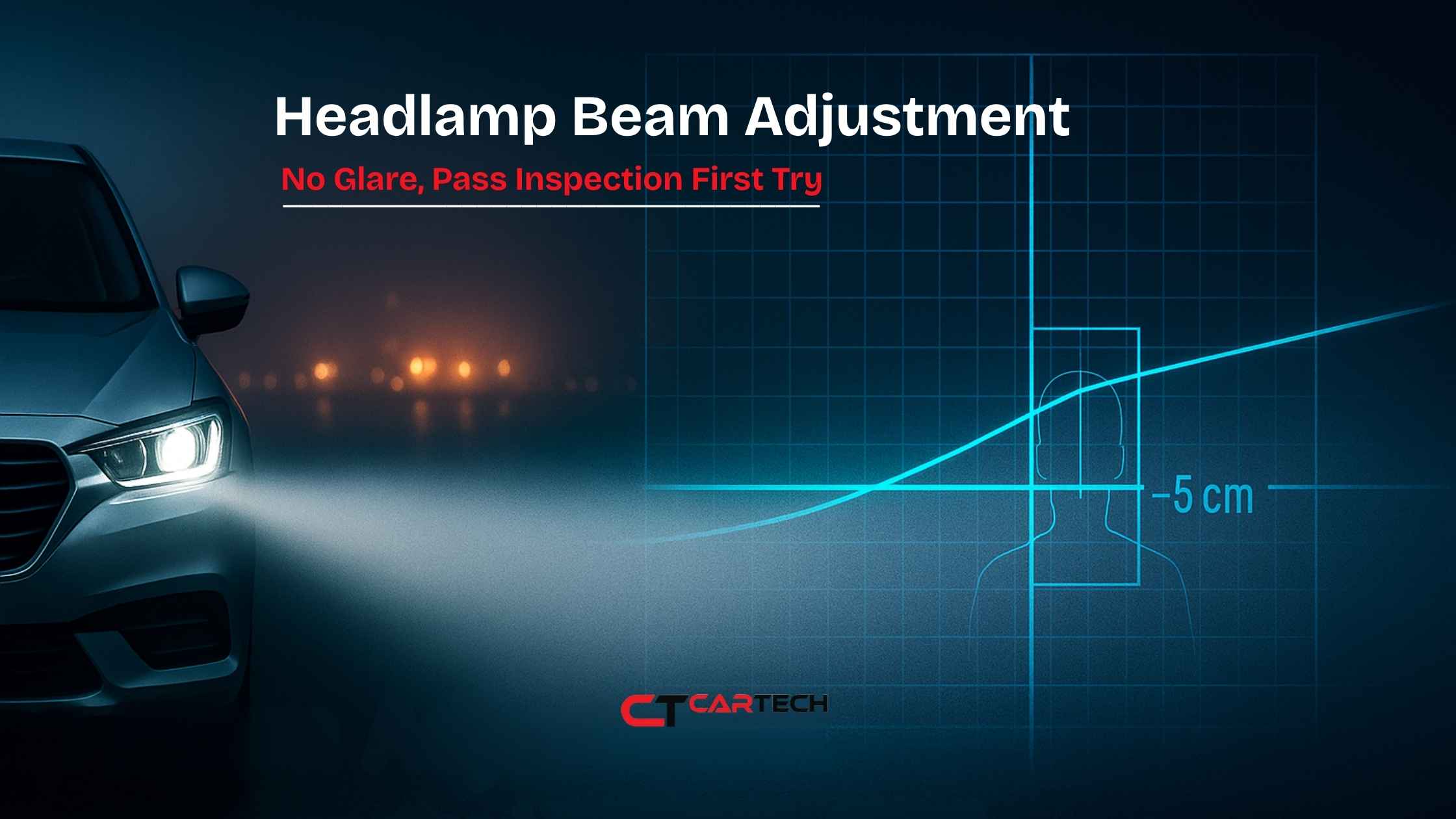
    5. Create the Target Line: This is the most crucial step. Measure 5 cm (about 2 inches) down from the Headlight Centerline and run another horizontal strip of tape. This lower line is your target for the beam’s cut-off.
    6. Adjust One Light at a Time: Cover one headlight with a thick towel or piece of cardboard. Turn on your low beams. The beam from the uncovered headlight should now be projected onto the wall.

    Fine-Tuning with the Headlight Leveling Screw

    Now for the adjustment itself. On the back of the headlamp assembly, you’ll find the adjuster screws. There are usually two: one for vertical (up/down) aim and one for horizontal (left/right) aim.

    • Using the correct tool, turn the vertical headlight leveling screw in small, quarter-turn increments. Feel the subtle click each detent offers—this helps you keep track of your adjustments.
    • Your goal is to align the flat part of the beam’s cut-off perfectly with the lower horizontal tape line on the wall.
    • The “kick-up” to the right should begin right at the vertical tape line that marks the headlight’s center.
    • Once the first light is perfect, cover it and repeat the same process for the other headlight.

    Common Mistakes and Instant Fixes

    • Sloppy Beam Pattern: If your cut-off line is blurry or indistinct, your bulb is likely not seated correctly in the housing. This is a prevalent issue after installing aftermarket LED bulbs without care. The solution is to remove the bulb and reinstall it, ensuring it locks into place perfectly. Poorly designed LEDs can also have this issue due to bad chip placement, which is why a quality assembly with good LED headlight heat dissipation is crucial.
    • Suspension Changes: If you’ve installed a lift kit, lowering springs, or even just carry heavy loads frequently, you MUST perform a headlamp beam adjustment. Changing the vehicle’s rake angle by even a couple of degrees can throw your aim off dramatically.
    • Forcing the Screw: The adjuster mechanisms are often made of plastic. If a screw feels seized, don’t force it. A small spray of lubricating fluid might help, but if it’s broken, the entire assembly may need replacement.

    Quick-Reference Aiming Drop Table

    While 5 cm is a great general rule, different vehicle types have slightly different ideal drops.

    Vehicle TypeRecommended Drop at 7.6mInspector Tolerance
    Sedan / Hatchback5.0 cm± 1.0 cm
    SUV / Crossover6.0 cm± 1.0 cm
    Light Truck / Van7.0 cm± 1.0 cm

    The Post-Adjustment Road Test

    The wall gives you the data, but the road gives you the proof. Take a drive on a quiet, dark road.

    • The cut-off should be visible and crisp, painting a precise ribbon of light across the road.
    • It should feel like you have excellent visibility for at least 60-80 meters ahead of you.
    • When a car approaches, your lights should not be hitting their windshield or side mirrors. This is the ultimate test to avoid headlight glare.

    Your Headlamp Inspection Checklist for Success

    On the day of your inspection, a little prep goes a long way.

    • Wipe your headlight lenses clean. A dirty lens can diffuse the beam and cause a failure.
    • Confirm all lights work—low beam, high beam, indicators, and parkers.
    • If you have a manual leveling dial inside your car (often numbered 0-3), make sure it is set to “0” for an unloaded vehicle.
    • Arrive with confidence, knowing you’ve done the job right.

    Conclusion

    Back in Keelung, a car with perfectly aimed headlights approaches. Its beam slices cleanly through the fog below your line of sight, illuminating the road for the driver without ever compromising your vision. A moment later, it’s gone, and you continue on your way safely. This is the standard we should all aim for. By mastering a proper headlamp beam adjustment, you’re not just preparing to pass an inspection. You’re becoming a safer, more courteous, and more responsible member of Taiwan’s driving community.

    Do you need the right tools for the job? Order our professional headlight alignment boards and bubble levels today. Or, if your assemblies are old and faded, explore our range of OEM-spec replacements like the brilliant LED Headlamp Assembly for the Vios 2018.

    Because the right light guides you—and everyone else—home.

    FAQs: Headlamp Beam Adjustment

    1. How far from the wall should I park my car for alignment?

    The industry standard is 7.6 meters, or 25 feet. Parking closer or farther away will change the geometry and result in an incorrect aim. Consistency is key.

    2. Do LED retrofit bulbs change the headlight aim?

    They shouldn’t change the aim if they are well-designed and installed correctly, but you should ALWAYS check your alignment after swapping bulb types. The physical position of the light-emitting source on the bulb is critical, and even a millimeter of difference can alter the beam pattern.

    3. What if my adjuster screw is seized or just keeps spinning?

    If a screw is seized, try a penetrating lubricant. If it spins freely without changing the aim, the internal mechanism is likely stripped or broken. Unfortunately, this usually requires replacing the entire headlamp assembly.

    4. Does putting heavy cargo in my trunk alter the beam height?

    Yes, absolutely. Heavy cargo in the trunk will squat the rear suspension and raise the front, causing your headlights to aim higher and create glare. This is why many modern cars have an auto-leveling system or a manual adjustment dial on the dashboard to compensate when carrying loads.

    Key Takeaways

    • Safety: Proper aim is your first line of defense in nighttime driving, allowing you to see hazards without blinding other drivers.
    • Compliance: A precise headlamp beam adjustment is one of the easiest ways to ensure you pass Taiwan’s annual vehicle inspection on the first try.
    • Coming up to your lights correctly is a fundamental act of respect for every other driver sharing the road with you.
    • Precision: Use the 7.6-meter distance, a level surface, and the 5 cm drop method for accurate, repeatable results every time.
  • DIY Water Pump Replacement: Torque, Belt & Air Bleed Tips

    DIY Water Pump Replacement: Torque, Belt & Air Bleed Tips

    It’s a steamy summer afternoon on Provincial Highway 9, the kind of day where the air itself feels heavy. You’re navigating the beautiful coastal curves when you notice it: the temperature needle, normally rock-steady, is creeping into the red. A quick pull-over confirms your fear—a tell-tale drip, drip, drip of green coolant from behind the main pulley. Your water pump has given up. For many, this means a tow truck and a hefty repair bill. But for you, it’s an opportunity. A proper diy water pump replacement is well within your reach.

    Here at CarTech, we believe that with the right parts, the proper knowledge, and a bit of patience, you can tackle this job with the confidence of a seasoned pro. I’ve spent years as a dealership technician, and I can tell you that a water pump job is all about process and precision. Let’s walk through it together.

    Why Water Pumps Fail: The Three Culprits

    A water pump is the heart of your engine’s cooling system, circulating coolant to keep temperatures in check. When it fails, it’s usually for one of three reasons:

    1. Bearing Wear: A high-pitched whine or grinding sound from the front of the engine is the classic sign of a failing bearing. This is often caused by an over-tightened serpentine or timing belt putting excessive strain on the pump’s shaft.
    2. Seal Fatigue: This is the most common failure, leading to the dreaded coolant leak. Old, acidic coolant breaks down the delicate seals that keep the liquid inside. This is why regular coolant flushes are so significant.
    3. Impeller Erosion: In rare cases, a phenomenon called electrolysis (caused by poor electrical grounding or contaminated coolant) can erode the pump’s impeller fins, reducing its ability to move fluid even if it isn’t leaking.

    Ignoring these symptoms is a direct path to engine overheating, which can cause catastrophic damage like a warped cylinder head.

    Your Tool & Part Checklist

    A successful job starts with having everything you need before you turn the first bolt. There’s nothing worse than having to stop mid-job for a tool run.

    • Tools:
      • A good metric socket set and ratchet
      • A calibrated torque wrench (this is non-negotiable!)
      • A drain pan (at least 8-liter capacity)
      • A plastic gasket scraper (never use metal on an aluminum engine block)
      • A set of pliers for hose clamps
      • A funnel, preferably a spill-proof one
      • Plenty of shop towels or rags
    • Parts:
      • Your new, OE-grade water pump from CarTech.tw
      • A new water pump gasket
      • Fresh, manufacturer-approved coolant (抗凍液)
      • Distilled water (if using concentrated coolant)

    The Removal Procedure: A Step-by-Step Guide

    Let’s get our hands dirty. We’ll use a typical serpentine-belt-driven pump as our example.

    1. Safety First: Park on a level surface and ensure the engine is completely cool. Disconnect the negative battery terminal.
    2. Drain the System: Place your drain pan under the radiator’s petcock or the lower radiator hose. Open the petcock or loosen the hose clamp to drain all the coolant.
    3. Loosen Pulley Bolts: Crucial tip: While the belt is still on and providing tension, use a wrench to “crack” loose the bolts holding the water pump pulley. Don’t remove them, just break their initial torque.
    4. Release Belt Tension: Locate the serpentine belt tensioner. If it’s an automatic tensioner, use a long-handled ratchet or breaker bar to pivot it and release the tension. Feel that sudden slack? The belt’s tension has just surrendered. Slip the belt off the water pump pulley.
    5. Remove the Pulley: Now you can easily spin off the pulley bolts you loosened earlier and remove the pulley itself.
    6. Unbolt the Old Pump: With clear access, remove the bolts holding the water pump to the engine block. Have a rag ready for any residual coolant that spills out. Gently pry the old pump off.

    Cleaning and Gasket Prep: The Foundation of a Good Seal

    This is the step that separates amateurs from professionals. A perfect seal is impossible on a dirty surface.

    • Clean the Mating Surface: Use your plastic scraper and a rag with some brake cleaner to remove every last trace of the old gasket and any corrosion. The surface should be immaculate and smooth.
    • Choose Your Gasket: Your new pump will come with the correct gasket. This could be a treated paper gasket, a metal-reinforced gasket, or an O-ring. For metal gaskets, install them dry. For paper, a very thin smear of gasket sealant can help hold it in place. The gasket is what seals the friendship between the two metal surfaces—treat it with respect.

    Installation and Water Pump Torque Specs

    Installing the new pump is all about even pressure. Never just tighten one bolt down.

    1. Position the new gasket and pump against the engine block.
    2. Hand-tighten all the bolts to snug the pump into place.
    3. Using your torque wrench, tighten the bolts in a criss-cross or star pattern to the exact specification. This ensures the pump sits perfectly flush.

    Water Pump Torque Specs for Common Engines

    Engine ModelBolt SizeCritical Torque (N·m)
    Mitsubishi 4G63 (Lancer Evo)M820-24 N·m
    Toyota 2ZR-FE (Altis/Vios)M819 N·m
    Honda K24A (Accord/CR-V)M612 N·m

    Note: These are common values. Always verify the spec for your specific vehicle if possible.

    Setting Correct Serpentine Belt Tension

    With the pump torqued down and the pulley reinstalled, it’s time for the belt.

    • Automatic Tensioners: These are easy. Simply pivot the tensioner, slip the belt back on following the correct routing diagram, and release the tensioner. It will apply the perfect amount of pressure automatically.
    • Manual Tensioners: These require a bit of feel. Tighten the adjuster until the belt is snug. The rule of thumb is that on the longest span of the belt, you should be able to twist it about 90 degrees with your fingers, but no more. It should feel taut, like a bass guitar string, not loose and floppy.

    The Art of the Cooling System Air Bleed

    You can’t just pour coolant in and drive away. Air trapped in the system will cause overheating. Bleeding it out is mission-critical.

    1. Get a Spill-Proof Funnel: This tool is a game-changer. It fits into the radiator neck and allows you to overfill the system slightly, using gravity to push air out.
    2. Raise the Front: Jack up the front of the car a few inches. Air rises, and this encourages bubbles to travel to the radiator, which is now the highest point.
    3. Locate the Bleed Screw: Many engines have a coolant bleed screw (放氣螺栓) on the thermostat housing or a high point on the engine. Loosen this slightly as you fill the system.
    4. Fill and Start: Fill the system through the funnel until you see a steady stream of coolant from the bleed screw, then tighten it. Start the engine with the heater on full blast to open the heater core valve.
    5. Burp the System: As the engine warms up and the thermostat opens, you’ll see bubbles “glug-glug” up into the funnel. This is the sound of success! Keep the funnel topped up until the bubbles stop. This can take 15-20 minutes.

    The Final Check: Leaks and Temperature Cycles

    Once the air is out, it’s time for the final road test.

    • Let the engine idle for at least 10 minutes. Use a flashlight to inspect your work, looking for any signs of leaks at the gasket or hoses.
    • Wait for the radiator cooling fan to cycle on and off at least twice. This confirms the thermostat is opening and the system is regulating temperature correctly.
    • For extra precision, use an infrared temperature gun aimed at the upper radiator hose. A reading of 90-95°C when the fan kicks on is a sign of a healthy system.

    Prevention and Maintenance Intervals

    A new water pump should last a long time, especially if you care for the cooling system. We recommend a full coolant drain and fill every 40,000 to 50,000 kilometers. It’s also wise to inspect all your belts and other fluid-moving components, like those handled by an expert oil pump supplier in Taiwan, at every major service interval.

    Conclusion

    You’re back on Highway 9. The sun is setting, but your eyes are fixed on the dashboard. The temperature needle is precisely where it should be, steady and calm. You can feel the cool mountain breeze through the vents because your heater is working perfectly. That’s the feeling of a job done right. You didn’t just replace a part; you took control of your vehicle’s health. This is the power of a successful diy water pump replacement.

    When you’re ready to tackle your next project, CarTech.tw is here with the OE-grade pumps and gaskets you need. And with our same-day auto parts delivery in Taiwan, you won’t have to wait to get started.

    Because engines deserve rivers, not steam.

    FAQs: DIY Water Pump Replacement (Torque, Belt Tension, Air Bleed)

    1. How long does a DIY water pump replacement take?

    For an experienced DIYer, the job typically takes 3 to 5 hours. If it’s your first time or if the pump is driven by the timing belt (which is a more complex job), plan for a full day to work carefully and not rush.

    2. Do I always need a new timing belt with the pump?

    If the timing belt drives your water pump, we recommend replacing the timing belt, tensioner, and idler pulleys at the same time. The labor is nearly identical, and it’s cheap insurance against a catastrophic belt failure.

    3. What torque wrench range is ideal for this job?

    A torque wrench with a range of approximately 10 to 100 N·m (Newton-meters) is perfect for water pump bolts, pulley bolts, and tensioner bolts.

    4. Why is my temperature gauge still high after bleeding the system?

    If you’ve thoroughly bled the system and the temperature is still climbing, you could have a stuck thermostat (that isn’t opening), a faulty radiator fan, or a blockage in the radiator itself. The new water pump is likely doing its job, but another component is failing.

    Key Takeaways

    • Confidence: This guide proves that with a methodical approach, a complex job like a water pump replacement is achievable for a dedicated DIYer.
    • Precision: Using a torque wrench and following the criss-cross pattern is not optional; it’s the secret to a leak-free seal.
    • Thoroughness: A successful job depends on meticulous cleaning of the mating surface and a patient, complete air-bleed procedure.
    • Peace-of-Mind: Doing the job right means you can trust your vehicle on long drives, knowing its cooling system is in top condition.
  • Brake Pad Wear Sensors: Diagnose, Replace & Reset Codes

    Brake Pad Wear Sensors: Diagnose, Replace & Reset Codes

    The mist hangs heavy on the winding roads of Alishan, each hairpin turn demanding respect and perfect brake control. Your headlights cut through the fog, brake lights glowing in the damp air. Then, a sudden, unwelcome chime from the dashboard, accompanied by a bright, insistent warning light. It’s a message from a tiny, often-overlooked component: a sentinel wire embedded in your brake pads, crying for help. This is the moment every professional technician and serious driver understands—the critical alert from your brake pad wear sensors.

    These sensors are more than just a convenience; they are a frontline safety system. For fleet managers keeping vehicles on the road and for workshops delivering reliable service, understanding how to diagnose, replace, and reset these components is essential. At CarTech, we see these sensors not as simple wires, but as a vital link in the safety chain. This guide is built for you—the professional who needs clear, actionable information to get the job done right.

    Why Brake Pad Wear Sensors Matter

    A brake pad wear sensor, or mó sǔn gǎn zhī xiàn (磨損感知線), is a crucial safety device that alerts the driver when brake pads have worn down to a minimum safe thickness. Ignoring this warning can lead to dangerous situations. According to a 2023 report from the U.S. National Highway Traffic Safety Administration (NHTSA), an estimated 22% of brake-related accidents can be traced back to overdue pad replacement. Here in Taiwan, data from the Ministry of Transportation and Communications (MOTC) highlights the risks of brake fade on mountainous descents like those on Alishan or Hehuanshan. Worn-out brake pads significantly amplify this risk.

    How Brake Pad Wear Sensors Work

    Early warning systems were purely mechanical—a small metal tab that would screech against the rotor when the pad was low. Today’s electronic systems are far more sophisticated. There are two primary types:

    1. Single-Stage Electrical Loop: This is the most common type. A simple wire loop is embedded in the sensor head. As the brake pad wears, the sensor head eventually makes contact with the spinning brake rotor, which grinds through the wire. This breaks the electrical circuit, triggering the warning light on the dashboard. It’s essentially a fuse designed to sacrifice itself to signal a problem.
    2. Two-Stage Resistor Sensors: Found on many modern European vehicles like BMW and Mercedes-Benz, these sensors are much smarter. They contain two parallel resistor circuits embedded at different depths within the sensor head. When the pad wears down to the first circuit, the resistance changes. The vehicle’s computer uses this data, along with inputs like mileage and braking force, to calculate the remaining pad life and display a service interval message (e.g., “Brake service in 2,000 km”). When the pad wears down to the second circuit, the loop breaks completely, triggering the urgent, non-resettable brake warning light.

    The materials used are also critical. The sensor body and wiring are typically insulated with high-temperature polymers like polyimide, which can withstand the extreme heat of the braking system, often rated for temperatures exceeding 250°C.

    How to Diagnose a Faulty Brake Pad Sensor

    A warning light doesn’t always mean the pads are worn. The sensor itself can fail. Here’s how to tell the difference.

    SymptomPossible Cause
    Persistent Warning Light (New Pads)Faulty/damaged sensor, broken wire, or incorrect reset procedure.
    Intermittent Warning LightLoose connection, corroded connector, or a wire that is intermittently shorting to ground.
    Warning Light On, But Pads Look OKThe sensor on the opposite side (often only one per axle) may be worn, or the sensor wire may be damaged.

    The Multimeter Test

    For a definitive diagnosis, use a digital multimeter.

    1. Disconnect the sensor from the vehicle’s wiring harness.
    2. Set your multimeter to measure resistance (Ohms, Ω).
    3. For a new, single-stage sensor, touch the probes to the two pins on the sensor’s connector. You should see a closed circuit, typically reading less than 1 Ω (a near-perfect connection).
    4. If the sensor has been worn through, it will read as an open loop (O.L. or infinite resistance).
    5. If the reading is high or fluctuating, it could indicate corrosion in the connector or internal damage to the wire.

    Checking OBD-II Codes

    A professional OBD-II scanner can provide more specific clues. While many basic sensors won’t throw a specific code, advanced systems might. Look for chassis codes (C-codes) such as:

    • C0050: Right Rear Wheel Speed Sensor Circuit Malfunction (can sometimes be related if systems are integrated).
    • C1234: (Manufacturer Specific) Often relates to brake system faults.
    • C101F00: A status message indicating a system function test is active, sometimes triggered after incorrect coding.

    Replacing Brake Pad Wear Sensors — A Step-by-Step Guide

    Replacing the sensor is a standard part of any professional brake job. Once a sensor has been triggered, it must be replaced; it cannot be reused.

    1. Safety First: Secure the vehicle on a lift or with jack stands on level ground. Never work under a car supported only by a jack.
    2. Wheel Off: Remove the wheel to access the brake caliper.
    3. Locate the Sensor: The sensor is typically fitted to the inboard brake pad on one wheel per axle (e.g., front-left and rear-right).
    4. Remove the Caliper: Loosen and remove the caliper guide pins or retaining clips. Secure the caliper to the suspension with a hook; never let it hang by the brake hose.
    5. Swap the Pads & Sensor: Remove the old brake pads. The old sensor will pull out of a slot in the pad. Install the new pads and firmly press the new sensor into place. Hear that reassuring click? That’s the clip accepting its new guard.
    6. Route the New Wire: Carefully unclip the old sensor wire from its mounting points along the suspension and brake line. Route the new wire along the same path. This is critical—a pinched or improperly routed wire will fail quickly.
    7. Reconnect and Reassemble: Connect the new sensor to the vehicle’s harness. Reinstall the caliper, ensuring guide pins are torqued to specification (e.g., a BMW F30 caliper guide pin is typically around 30 N·m).
    8. Final Check: Reinstall the wheel and torque the lug nuts to the manufacturer’s spec.

    How to Reset the Brake Pad Wear Code and Service Interval

    With new pads and sensors installed, the final step is telling the car’s computer.

    Method 1: In-Vehicle Menu Reset (e.g., BMW iDrive)

    Many European vehicles allow you to reset the service interval directly from the dashboard.

    1. Get in the car, close the door, and press the Start/Stop button once without your foot on the brake to enter accessory mode.
    2. Wait for any initial warnings to clear.
    3. Press and hold the trip reset button on the instrument cluster.
    4. The service menu will appear. Use short presses of the button to cycle through the options (e.g., Oil, Front Brakes, Rear Brakes).
    5. When you reach the desired brake service, press and hold the button again, and a “Reset?” prompt will appear.
    6. Release and press and hold one more time to confirm. A progress bar will appear, and the service will reset to a new, complete interval.

    Method 2: OBD-II Scanner Reset

    For some vehicles or more persistent codes, a professional scan tool is the best option.

    1. Connect your scanner to the OBD-II port.
    2. Navigate to the Chassis or ABS control module.
    3. Select the option for “Brake Pad Service Reset” or “Clear Fault Codes.”
    4. Follow the on-screen prompts to complete the reset. Be wary of counterfeit scanners, which can sometimes fail to communicate properly or even damage vehicle electronics.

    A Taiwan Taxi Fleet

    We recently partnered with a major taxi fleet in Taipei to study the real-world benefits of diligent sensor replacement. The fleet manager, Ms. Lin, was concerned about vehicle downtime due to unexpected brake warnings. Over a six-month trial on 50 vehicles, we implemented a strict policy of replacing pads and sensors before the final warning light was triggered, based on the two-stage sensor’s initial service alerts.

    The results were clear: The fleet saw an average brake pad life extension of 12% by avoiding premature replacement while also eliminating emergency service calls. “The biggest win wasn’t just the cost savings on pads,” Ms. Lin told us. “It was the predictability. We could schedule brake service during off-peak hours, keeping our cars on the road, making money. The ROI was instant.”

    Troubleshooting Corner

    • Warning Light Flashing After Reset? This can indicate cross-talk from a faulty wheel speed sensor or a problem within the ABS module itself. A full diagnostic scan is needed.
    • High Resistance Reading on a New Sensor? Suspect corrosion in the main vehicle-side connector, a common issue in Taiwan due to high humidity and coastal sea salt spray (hǎi yán wù – 海鹽霧). Clean the connector with a specialized contact cleaner.

    Future Tech Outlook

    The humble wear sensor is getting smarter. We are actively tracking innovations like:

    • Wireless Brake Pad Sensors: Companies like Continental are prototyping sensors that use Bluetooth Low Energy (BLE) to communicate pad wear, eliminating physical wires that can be damaged.
    • Predictive Maintenance Algorithms: The future lies in software. By analyzing braking patterns, vehicle weight, and temperature, advanced algorithms can predict pad life with incredible accuracy. Recent technical papers from organizations like SAE International explore how machine learning can make braking systems safer and more efficient.

    Conclusion

    Back on the misty Alishan road, the descent is now confident and controlled. The warning light is off, a silent confirmation of a job done right. From the fleet manager in Kaohsiung to the independent workshop in Taichung, understanding brake pad wear sensors is fundamental to modern vehicle service. It’s about more than just replacing a part; it’s about ensuring safety, building customer trust, and keeping Taiwan’s roads moving efficiently.

    Do you need the right parts for the job? Chat with our parts desk for expert advice or download our complete bilingual brake systems catalogue today. We offer everything from pads and rotors to the sensors that guard them, with services like same-day auto parts delivery in Taiwan to keep your workshop running smoothly.

    Because stopping power isn’t negotiable—it’s mission-critical.

    FAQs: Brake Pad Wear Sensors (Diagnose, Replace & Reset Codes)

    How many kilometers are left when a brake pad wear sensor triggers?

    For a single-stage sensor, the warning light typically illuminates when there are approximately 1,500 to 3,000 kilometers of safe driving left, depending on the vehicle manufacturer and driving style. Two-stage sensors provide an earlier, mileage-based warning before the final, critical alert. 

    Can I bypass a faulty brake pad wear sensor temporarily?

    On older, single-loop systems, technicians sometimes cut the sensor connector and splice the two wires together to close the circuit and turn off the light. However, we strongly advise against this. It is an unprofessional repair that turns off a key safety feature. This bypass will not work on modern two-stage resistor-based systems and will still result in a fault code. 

    Does replacing brake pads always require a new sensor?

    Yes. It is best practice to replace the brake pad wear sensor every time you replace the brake pads. Even if the sensor hasn’t been triggered, the plastic and wiring endure extreme heat cycles, which can make them brittle and prone to failure. Given their low cost, it is wise to do preventative maintenance. 

    How accurate are two-stage sensors compared to single-loop sensors?

    Two-stage sensors are significantly more advanced. While a single-loop sensor only provides one “on/off” warning, a two-stage sensor provides predictive data. By calculating remaining life based on wear at the first stage, this approach enables proactive maintenance scheduling, which is more precise and efficient for both drivers and service centers. 

    Key Takeaways

    • Safety: Functioning sensors are critical for preventing accidents caused by worn-out brakes.
    • Cost-Efficiency: Timely replacement based on sensor warnings prevents costly damage to brake rotors.
    • Precision: Two-stage sensors offer predictive maintenance data, allowing for efficient fleet management and customer service.
    • Integrity: Always replace sensors with new pads; bypassing them is an unsafe practice that should be avoided.
    • Accuracy: A proper reset procedure (via vehicle menu or OBD-II tool) is required after replacement to ensure the system works correctly
  • LED Headlight Heat Dissipation: Aluminum Fins vs Fans

    LED Headlight Heat Dissipation: Aluminum Fins vs Fans

    The Taipei night air is thick enough to drink, a humid cocktail of scooter exhaust and the aroma of stinky tofu from a nearby night market. A river of red taillights flows down Zhongxiao East Road. Your headlights cut through the haze, two beams of brilliant, clean white light. Inside each of those modern marvels is a tiny sun—an LED chip no bigger than your pinky nail, blazing with intensity. But like any star, this tiny sun generates immense heat. Taming that heat is the single most critical factor in modern lighting design. Without effective LED headlight heat dissipation, that brilliance will fade, and the tiny sun will burn itself out far too soon.

    At CarTech.tw, we live and breathe this challenge. We understand that for our professional partners—the workshops, parts buyers, and serious DIYers who are the backbone of Taiwan’s automotive scene—a headlight isn’t just a part. It’s a promise of safety, performance, and reliability. This article dives deep into the heart of the matter: the two rival technologies battling to keep that promise. In one corner, we have the silent, stoic, passive aluminum fin. In the other, the energetic, high-performance active micro-fan. It’s a classic engineering face-off, and choosing the winner depends entirely on your specific needs.

    Why LED Headlight Heat Dissipation Matters

    An LED isn’t like an old halogen bulb, which loves to run hot. LEDs are semiconductors, and they are sensitive to temperature. While they convert a good portion of energy into light, the rest becomes heat, right at the chip. If that heat isn’t drawn away efficiently, the consequences are severe:

    • Reduced Lifespan: It’s a brutal rule of thumb in semiconductor physics: for every 10°C increase in an LED’s operating temperature, its useful life can be cut by as much as 30-50%. An LED rated for tens of thousands of hours could fail in a fraction of that time without proper cooling.
    • Decreased Lumen Output (Light Decay): As an LED chip gets hotter, its efficiency drops. The light it produces becomes dimmer, a phenomenon known as lumen depreciation. This isn’t just a minor annoyance; it’s a safety issue.
    • Color Shift: Extreme heat can degrade the phosphor coating on white LEDs, causing the crisp, white light to shift towards a cooler, bluer, and less effective hue.
    • Component Failure: It’s not just the LED chip at risk. The driver, circuitry, and other electronic components within the bulb assembly can be damaged or destroyed by excessive heat, leading to complete failure.

    The stakes are high. Headlight failures are a significant safety concern, and effective thermal management is the first line of defense.

    How Passive Aluminum Fins Work

    Think of passive cooling as the strong, silent type. It relies on fundamental physics—conduction and convection—to move heat away from the LED chip. The primary component here is the heat sink (散熱片), a meticulously designed piece of metal that acts like a superhighway for thermal energy.

    Material Science—6063-T5 Alloy Explained

    Not all aluminum is created equal. While many manufacturers use standard 6061 aluminum, we at CarTech have standardized on 6063-T5 alloy for our passive heat sinks. The reason is simple: it has vastly superior thermal properties. This specific alloy can pull heat away from the LED chip much more effectively than common 6061 aluminum, a critical advantage that translates directly into better performance and longevity. Furthermore, 6063 is excellent for extrusion, allowing us to create more complex and efficient fin designs.

    Fin Geometry (Surface Area, Spacing, and CFD Insights)

    The goal of a heat sink is to maximize its surface area to dissipate heat into the surrounding air. This is where geometry becomes critical.

    • Surface Area: More fins and deeper fins mean more surface area.
    • Spacing: The fins can’t be too close together, or they will trap a boundary layer of hot air, choking off convection.
    • Airflow: The design must account for natural air movement within the headlight housing.

    In our lab, we use Computational Fluid Dynamics (CFD) software to model airflow around our heat sink designs before we even machine a prototype. An early design for a popular sedan model looked great on paper, but our CFD analysis showed a hot spot developing at the base of the central fins due to air stagnation. By slightly angling the outer fins and increasing the gap by just 1.5mm, we improved overall heat dissipation by 12% without changing the footprint. This is the level of detail that separates a good part from a great one.

    How Active Fan Systems Work

    If passive fins are the silent heavy-lifters, active fan (風扇) systems are the high-energy pit crew. They don’t wait for natural convection; they create their airflow using a miniature, high-RPM fan to force cool air across the heat sink. This forced convection is dramatically more effective at removing heat, which allows for higher-power LEDs and brighter output in a more compact design.

    RPM, Bearing Types, and Noise dB Ratings

    The heart of the active system is the micro-fan itself. Key specs to consider are:

    • RPM (Revolutions Per Minute): Higher RPMs generally mean more airflow (measured in CFM, or Cubic Feet per Minute), but also more noise.
    • Bearing Type: This is crucial for longevity. Cheaper sleeve bearings are quiet initially but wear out much faster, especially in high-heat environments. We insist on dual-ball bearings, which are far more durable, better handle heat, and are designed for a much longer operational lifespan.
    • Noise (dB): No one wants their headlights to buzz. A quality micro-fan should operate between 25 and 35 dBA. To put that in perspective, 35 dBA is about the level of a very quiet room fan on low or a whisper. Anything approaching 40 dBA becomes noticeable.

    Dust & Humidity Challenges in the Taiwan Climate

    Here in Taiwan, we face a unique environmental challenge: high humidity and airborne particulates. This combination is the enemy of micro-fans. Dust can clog the fan blades and, more critically, work its way into the bearing, causing premature failure. Humidity can accelerate corrosion.

    That’s why our fan-cooled systems use IP55-rated fans, which are protected against dust ingress and low-pressure water jets. This is a non-negotiable feature for durability in our climate.

    Aluminum Fins vs Active Fans—Side-by-Side Comparison

    FeaturePassive Aluminum FinsActive Fan System
    Cooling EfficiencyGood to Very GoodExcellent
    DurabilityExcellent (no moving parts)Good (bearing is a wear item)
    MaintenanceNonePeriodic cleaning recommended
    CostLowerHigher
    WeightHeavier (requires more mass)Lighter
    Install SpaceLarger footprint requiredMore compact design is possible
    NoiseSilent (0 dB)Low (25-35 dB)
    Best ForExtreme reliability, off-road, dusty environmentsMaximum brightness, tight spaces

    Field Test—CarTech Lab Data

    To quantify the difference, we put our top-performing passive and active systems on the test bench. We call it rig #LH-07. We placed each LED bulb inside a standard headlight housing and let it “soak” for 4 hours in a controlled 40°C ambient environment, simulating a hot summer day with the engine running.

    • The Setup: A high-output 45W LED chip on both units.
    • The Test: Continuous operation with thermal probes attached to the LED base.
    • The Results: Our thermal couple, monitoring the passive fin unit, bristled as the temperature climbed, finally stabilizing at 98°C. A solid performance, but close to the thermal threshold. The active fan unit was a different story. Its fan spun up to a steady 7,000 RPM, and the temperature stabilized at a cool 85°C. That 13°C difference is massive in the world of semiconductors, translating directly to a longer, brighter life for the LED.

    Buyer’s Checklist: Choosing the Right System for Your Vehicle

    So, which system is right for you? It’s not just about which is “better,” but which is better for your application.

    • Daily Taipei Traffic Warrior? If you spend a lot of time in stop-and-go traffic with little natural airflow, an active fan system provides consistent cooling when you need it most.
    • Limited Engine Bay Space? In modern, cramped engine bays like that of a 2019 Mazda3, the smaller physical footprint of an active fan bulb can make installation much easier.
    • Weekend Off-Roader in a Delica 4×4? For vehicles that see heavy vibration, dust, and potential water exposure, the rock-solid reliability of passive aluminum fins is unbeatable. There are no moving parts to fail.
    • Seeking Maximum Brightness? If raw lumen output is your top priority for dark mountain roads, the superior cooling of an active fan allows the LED to be driven harder and shine brighter.

    Installation & Maintenance Tips

    1. Always Test Fit: Before final installation, ensure the heat sink or fan assembly has at least 1 cm of clearance from any dust caps or engine components.
    2. Use Dielectric Grease: Apply a small amount to the electrical connectors to prevent moisture intrusion and corrosion.
    3. Check the Seal: Ensure the headlight housing’s rear dust cap is properly sealed to keep out moisture and dust.
    4. Listen to Your Fans: For active systems, give them a quick listen every few months. Hear that faint whirr? That’s the sound of performance. If it gets loud or gritty, it’s pleading for a blast of compressed air to clear out dust. A quick clean every 10,000 km is a good practice.

    Future Tech: Graphene Pads and Vapor Chambers

    The world of 車燈散熱 (chē dēng sàn rè – car light heat dissipation) is constantly evolving. We’re closely watching developments in:

    • Graphene Thermal Pads: These ultra-thin materials offer exceptional thermal conductivity and could replace traditional thermal paste for more efficient heat transfer.
    • Vapor Chambers: Borrowed from high-performance computing, a vapor chamber is like a flat, super-efficient heat pipe that can spread heat over a large area very quickly. Cutting-edge research shows promising results for these technologies in automotive applications, especially for cooling the next generation of high-power LED arrays.

    Conclusion

    The humid Taipei night is still buzzing, but your drive is clearer, brighter, and safer. That tiny sun inside your headlight is perfectly harnessed, its brilliance managed by precision engineering. Whether you choose the steadfast silence of aluminum fins or the powerful performance of an active fan, understanding the principles of LED headlight heat dissipation empowers you to make the best choice for your vehicle and your customers.

    Ready to upgrade? Chat with our parts specialists to find the perfect fit for your needs, or download our complete bilingual lighting catalogue. For those working on specific models like the Toyota Vios, check out our complete LED Headlamp Assembly for the Vios 2018.

    Because brilliance should blaze the road—not burn itself out.

    FAQs: LED Headlight Heat Dissipation (Aluminum Fins vs Fans)

    Do aluminum fin heat sinks cause radio interference (EMI)?

    High-quality LED bulbs with passive aluminum fins should not cause electromagnetic interference (EMI). The heat sink itself is a passive component. Interference issues typically stem from poorly shielded driver electronics within the bulb, not the cooling method. At CarTech, all our bulbs are EMC-certified to prevent interference with your radio or other vehicle electronics.

    How loud are LED headlight fans in decibels?

    A quality LED headlight fan should be very quiet, typically operating in the 25-35 dBA range. This is quieter than the background noise of a typical car’s air conditioning system and is generally inaudible from inside the cabin once the engine is running.

    Can I pass the annual vehicle inspection in Taiwan with aftermarket LED cooling systems?

    Yes, as long as the installed LED bulb meets the legal requirements for beam pattern, color temperature, and brightness. The cooling method (fins or fan) does not affect inspection eligibility, provided the bulb is correctly installed and does not create glare for other drivers. All CarTech lighting products are designed to meet Taiwan’s vehicle regulations.

    How often should I clean the micro-fans on my LED headlights in Taiwan’s climate?

    Given Taiwan’s high humidity and dust levels, we recommend a quick visual inspection and cleaning every 10,000 kilometers or at every oil change. A gentle blast of compressed air is usually sufficient to dislodge any accumulated dust from the fan blades and heat sink, ensuring optimal performance.

    Key Takeaways

    • Heat is the Enemy: Unmanaged heat drastically reduces the lifespan and brightness of LED headlights.
    • Passive Fins: Offer silent, maintenance-free operation and are highly durable, making them ideal for rugged conditions.
    • Active Fans: Provide superior cooling efficiency, allowing for brighter, more compact designs, but require quality bearings for long life.
    • Taiwan’s Climate Matters: High humidity and dust favor sealed fan bearings or robust passive fin designs.
    • Choose for Your Use Case: The best system depends on your vehicle, driving habits, and priorities—whether that’s maximum brightness, installation ease, or ultimate reliability.
  • The Ultimate Air Filter Comparison for Honda Civic and Accord Owners

    The Ultimate Air Filter Comparison for Honda Civic and Accord Owners

    As a Honda Civic or Accord owner in Taiwan, you’re probably aware of the importance of maintaining your vehicle’s performance and efficiency. One critical yet overlooked component is your air filter. In this comprehensive air filter comparison article, Cartech guides you through OEM, aftermarket, and performance air filters, helping you choose the best option for your car, budget, and driving style. Explore the ultimate air filter comparison for Honda Civic and Accord.

    OEM vs. Aftermarket vs. Performance Air Filters: What’s the Difference?

    1. OEM (Original Equipment Manufacturer) Air Filters

    OEM filters, supplied by Honda dealerships or authorized service centers, are specifically designed for your Civic or Accord. They provide:

    • Exact fitment: Ensures straightforward installation and reliable performance.
    • Reliable quality: Meets Honda’s rigorous specifications for filtration and airflow.
    • Warranty-friendly: Using OEM air filters helps maintain your vehicle’s warranty coverage.

    2. Aftermarket Air Filters

    Aftermarket filters from third-party brands offer attractive pricing and availability. However, quality can vary significantly.

    • Affordable: Usually cheaper than OEM.
    • Wide variety: Many brands and types are available in Taiwan.
    • Quality variation: Some aftermarket products match or even exceed OEM standards, while others may fall short.

    3. Performance Air Filters

    Performance air filters (brands like K&N, AEM, HKS, and Blitz) are engineered for enthusiasts aiming for increased horsepower, torque, and throttle response.

    • Reusable: Often washable and reusable, reducing long-term costs and waste.
    • Enhanced airflow: Improves engine breathing, potentially boosting horsepower.
    • Higher cost upfront: Typically more expensive initially, but cost-effective over time if properly maintained.

    Impact on Fuel Efficiency and Engine Performance

    The type of air filter you choose directly affects your Honda’s fuel efficiency and engine performance:

    Filter TypeFuel EfficiencyEngine Performance
    OEMOptimal baselineReliable, standard
    AftermarketVaries by brandCan match OEM if high-quality
    PerformanceSlight improvementNoticable improvement
    • OEM filters offer reliable, predictable fuel efficiency and performance.
    • High-quality aftermarket filters can match OEM filters in terms of performance and efficiency, though cheaper ones may negatively affect both.
    • Performance filters usually improve airflow, enhancing throttle response and slightly improving fuel efficiency, especially noticeable during spirited driving or highway scenarios.

    Price Comparison of Air Filter Brands Available in Taiwan

    Here’s a quick overview of popular air filter options available in Taiwan for your Civic or Accord:

    BrandTypeApproximate Price (NTD)
    Honda OEMOEM600 – 1,000
    VIC / BoschAftermarket350 – 700
    K&N PerformancePerformance2,500 – 3,500
    AEM DryFlowPerformance2,000 – 3,000
    HKS Super HybridPerformance2,000 – 3,000

    Cartech.tw Tip: While OEM filters have a lower initial cost, performance filters’ reusable nature provides long-term savings.

    Installation Difficulty and Maintenance Requirements

    OEM and aftermarket standard filters:

    • Easy to install (usually less than 10 minutes).
    • Recommended replacement every 10,000 – 15,000 km in Taiwan’s humid and dusty conditions.

    Performance filters:

    • Installation is slightly more complex if part of a full intake system.
    • Regular cleaning and re-oiling (approximately every 25,000 – 40,000 km). Requires additional time and maintenance products.

    Taiwan-Specific Environmental Considerations for Filter Selection

    Taiwan’s humid subtropical climate and urban areas’ pollution levels necessitate careful air filter selection:

    • High humidity and rainfall can lead to moisture and mold accumulation in cheaper aftermarket filters, negatively affecting engine performance.
    • Urban air pollution (especially in Taipei, Taichung, and Kaohsiung) means filters clog faster; regular inspections and replacements are crucial.
    • Performance filters are particularly advantageous here, as their washable and reusable nature allows regular maintenance to mitigate frequent replacements due to pollution.

    Conclusion: Which Air Filter is Right for Your Honda Civic or Accord?

    • Practical Owners: OEM or reputable aftermarket filters (e.g., VIC, Bosch) offer reliable, cost-effective performance with minimal hassle.
    • Enthusiasts: Performance filters from trusted brands (K&N, AEM, HKS) provide improved throttle response, slight efficiency gains, and long-term savings with proper maintenance.

    For more detailed automotive insights and guides specifically tailored for you, keep following the Cartech blog!

  • Performance Modifications for Subaru WRX: Tuning Scene Guide

    Performance Modifications for Subaru WRX: Tuning Scene Guide

    Taiwan’s dynamic automotive tuning scene has embraced the Subaru WRX, a car that perfectly blends performance, agility, and daily practicality. Whether you’re a seasoned enthusiast or new to performance modifications, understanding local trends, regulations, and the best resources is crucial. In this comprehensive Cartech blog, we’ll explore the essential performance modifications for your Subaru WRX, tailored specifically for Taiwan’s roads and tuning culture. Let’s dive into the best-known upgrades, reputable local shops, and crucial regulatory considerations to elevate your driving experience.

    Popular Engine Performance Modifications

    Performance modifications typically begin under the hood. For Subaru WRX owners in Taiwan, quality engine upgrades are key to unlocking the vehicle’s true potential. Here are the most popular engine-related performance modifications:

    1. Intake Systems

    Upgrading your WRX’s intake system is one of the most straightforward and effective performance modifications. High-quality cold air intakes from brands such as Cobb, AEM, and Mishimoto are common choices available through reputable Taiwanese dealers. These systems provide improved airflow, increased horsepower, and enhanced engine sound.

    2. Exhaust Systems

    Full exhaust systems are among the most popular performance modifications in Taiwan’s Subaru tuning community. Particularly, cat-back and turbo-back systems from brands like Invidia, HKS, and Fujitsubo are widely available and greatly improve exhaust flow, throttle response, and overall performance.

    3. ECU Tuning

    ECU tuning is an essential step when pursuing serious performance modifications. Custom tunes, such as those offered by local specialists available on Cartech.tw, can precisely optimize your Subaru WRX’s performance parameters, including boost pressure, fuel delivery, and ignition timing. A professionally executed ECU tune maximizes performance gains and overall drivability.

    Suspension Upgrades Tailored for Taiwan’s Roads

    Taiwanese roads range from smooth highways to challenging mountain routes. To ensure optimal driving dynamics and comfort, suspension upgrades are a vital part of WRX performance modifications.

    • Coilovers: Adjustable coilovers from brands like BC Racing (widely available in Taiwan), TEIN, and KW Suspension are popular performance modifications. These offer adjustable ride heights, damping rates, and better handling suited to Taiwan’s varied road conditions.
    • Sway Bars and Bushings: Upgrading sway bars and bushings significantly improves cornering stability and reduces body roll. Taiwanese roads often feature sharp turns and uneven surfaces, making such upgrades particularly beneficial.

    Exterior Modifications Compliant with Taiwan Regulations

    Taiwan’s authorities enforce strict regulations around vehicle modifications, especially in terms of exterior upgrades. Here are popular and legal exterior performance modifications for your Subaru WRX:

    1. Aerodynamic Kits

    Subtle aerodynamic enhancements such as front lips, side skirts, and small rear spoilers from reputable manufacturers are legal and popular. Brands like STI, Varis, and APR are common choices.

    2. Wheels and Tires

    Performance wheels and tires are essential for improving handling and aesthetics. Lightweight wheels from Rays, Enkei, and Work Wheels, combined with performance tires from Michelin or Bridgestone, are both popular and compliant with local regulations.

    3. Lighting Upgrades

    LED and HID lighting upgrades are popular exterior performance modifications that enhance visibility and aesthetics while adhering to Taiwan’s automotive lighting regulations, provided they are installed properly and meet brightness guidelines.

    Performance Testing and Legal Considerations

    Before hitting the road, be aware of Taiwan’s legal requirements associated with performance modifications. Here are some critical considerations:

    • Annual Vehicle Inspections: Modified exhaust systems, lighting, and suspension setups must comply with Taiwan’s vehicle inspection standards. Ensure your modifications meet these criteria to avoid costly fines or vehicle impoundment.
    • Certification: For significant modifications like ECU tuning, ensure your tuner provides proper certification or documentation ensuring compliance with local emissions and safety standards.
    • Performance Testing: Trusted shops regularly offer dyno testing and alignment checks post-modification, ensuring your WRX performs optimally and safely within legal parameters.

    Conclusion

    Navigating performance modifications for your Subaru WRX in Taiwan can significantly enhance your driving experience. By selecting quality parts, working with reputable tuners, and carefully adhering to local regulations, you can confidently customize your WRX while maximizing safety and performance. For detailed guides, reputable shops, and expert advice, regularly check Cartech blog articles on Cartech.tw.

  • Essential Interior Accessories for The New Hyundai Tucson Owners

    Essential Interior Accessories for The New Hyundai Tucson Owners

    Congratulations on your new Hyundai Tucson! As one of Taiwan’s most popular SUVs, the Tucson offers remarkable comfort, practicality, and style. However, enhancing your vehicle’s interior with the right accessories can significantly boost your driving experience. At Cartech.tw, we’ve carefully curated a guide to the essential interior accessories every new Tucson owner, focused on comfort, convenience, and protection against Taiwan’s unique climate, should consider. Dive into this detailed Cartech blog to discover the Interior Accessories for Hyundai Tucson.

    1. All-Weather Floor Mats for Taiwan’s Rainy Season

    Given Taiwan’s frequent rainfall, protecting your Tucson’s interior from moisture, mud, and dirt is crucial. All-weather floor mats are among the most essential interior accessories you can invest in. They offer:

    • Robust Protection: Durable materials withstand heavy rain and prevent water from seeping into your vehicle’s carpeting.
    • Easy Cleaning: Simply remove and rinse them to maintain cleanliness inside your Tucson.
    • Custom Fit: Mats specifically designed for the Hyundai Tucson ensure a perfect fit.

    2. Seat Covers and Protection Options

    Seat covers are another vital category of essential interior accessories. They protect your seats from spills, stains, and general wear and tear—ideal for families or frequent commuters. Consider:

    • Breathable Materials: Choose covers made from breathable fabrics to keep comfortable during Taiwan’s humid summers.
    • Easy Installation and Maintenance: Opt for covers that are simple to install and remove for convenient washing.
    • Luxury and Comfort: High-quality seat covers can enhance comfort, making your drives more enjoyable.

    3. Storage Solutions and Organizers

    A clutter-free environment significantly enhances driving comfort. Storage solutions and organizers are must-have essential interior accessories. Key options include:

    • Console Organizers: Neatly arrange your essentials, such as sunglasses, keys, and wallet.
    • Trunk Organizers: Keep your groceries, sports gear, or outdoor equipment tidy and secure.
    • Seatback Organizers: Useful for families to store tablets, toys, and snacks within easy reach.

    4. Climate-Appropriate Window Tinting Options

    Considering Taiwan’s intense sunlight and heat, window tinting is among the most beneficial essential interior accessories. Benefits include:

    • UV and Heat Protection: Effectively reduces interior heat buildup and harmful UV rays, protecting your family and upholstery.
    • Enhanced Privacy: Enjoy greater privacy and security while parked or driving.
    • Improved Comfort and Efficiency: A cooler interior means less reliance on air conditioning, improving fuel efficiency.

    5. Technology Accessories (Phone Mounts, USB Chargers)

    In our increasingly connected world, tech accessories have become indispensable essential interior accessories. Essential technology add-ons for your Tucson include:

    • Phone Mounts: Effortlessly navigate maps and take calls hands-free, enhancing safety and convenience.
    • Multi-Port USB Chargers: Keep all devices charged, perfect for family road trips or daily commuting.
    • Wireless Charging Pads: Integrated seamlessly with Tucson’s interior aesthetics, providing clutter-free charging.

    Final Thoughts from Cartech.tw

    Every new Hyundai Tucson owner in Taiwan deserves a comfortable, convenient, and well-protected driving experience. Investing in these essential interior accessories will not only enhance your daily driving comfort but also prolong the life and value of your vehicle. For more detailed reviews, tips, and purchasing advice, follow our regular updates on the Cartech blog, your trusted source for automotive insights.

  • Custom Bumper Options for Toyota RAV4 Owners: Style Meets Functionality

    Custom Bumper Options for Toyota RAV4 Owners: Style Meets Functionality

    As a Toyota RAV4 owner in Taiwan, you’re likely familiar with the challenges and opportunities the local roads present. From bustling city streets to winding mountain roads, the right bumper doesn’t just enhance your vehicle’s appearance—it significantly improves its functionality. At Cartech, we understand this balance. In this Cartech blog, we’ll explore popular custom bumper options for Toyota RAV4, highlighting styles, materials, installation details, pricing, and functional benefits.

    Popular Bumper Styles and Designs for RAV4 in Taiwan

    When considering custom bumper options for your Toyota RAV4, several popular styles resonate with Taiwanese drivers who value both practicality and aesthetics:

    • Off-road Style Bumpers: Rugged and robust, these bumpers often feature reinforced steel or aluminum construction, additional fog lights, and prominent tow hooks. Ideal for mountainous terrain and rural areas common throughout Taiwan.
    • Sporty Aero Kits: Sleek, aerodynamic designs perfect for urban driving, these bumpers enhance vehicle handling at higher speeds and provide a modern, aggressive look.
    • OEM-Plus Designs: Slightly modified original equipment manufacturer (OEM) designs, popular among owners who prefer subtle customizations. These bumpers blend seamlessly with the original vehicle aesthetics while offering improved durability.

    Material Comparisons: Plastic, Fiberglass, Carbon Fiber

    Selecting the right material for your RAV4 bumper affects not only the style, but also durability, weight, and cost:

    Plastic (ABS/Polyurethane):

    • Pros: Affordable, lightweight, easy to replace.
    • Cons: Less resistant to heavy impacts; tends to crack or deform under severe conditions.

    Fiberglass:

    • Pros: Lightweight, customizable shapes, and very affordable.
    • Cons: Brittle when impacted; may require extensive repair or replacement after collisions.

    Carbon Fiber:

    • Pros: Extremely lightweight, high strength-to-weight ratio, premium appearance.
    • Cons: Higher cost, specialized installation and repair.

    Installation Complexity and Professional Installation Options in Taiwan

    While some bumpers, especially plastic OEM styles, can be straightforward to install, more specialized custom options like off-road bumpers or carbon fiber kits often require professional installation. Many Taiwanese automotive shops offer comprehensive installation services, ensuring precise fitment and secure mounting. Cartech.tw recommends seeking professional installation to guarantee safety, durability, and optimal performance.

    Cost Ranges for Different Bumper Types

    Budgeting for custom bumper options is an essential step. Here’s a general pricing overview for RAV4 bumpers in Taiwan:

    Bumper TypeTypical Price Range (NTD)
    Plastic (OEM-style)5,000 – 15,000
    Fiberglass (Sporty Aero)8,000 – 20,000
    Carbon Fiber20,000 – 50,000+
    Off-road Steel/Aluminum15,000 – 35,000

    Prices can vary based on design complexity, brand reputation, and additional features such as integrated lighting or tow mounts.

    Functional Benefits for Taiwan’s Roads

    Custom bumpers aren’t just a visual upgrade—they offer significant practical advantages for Taiwan’s unique driving conditions:

    • Enhanced Protection: Durable bumpers, especially off-road styles, provide increased protection against minor collisions, parking mishaps, and road debris common in urban and rural Taiwan.
    • Improved Ground Clearance: Off-road bumpers typically offer better approach angles and ground clearance, ideal for navigating steep driveways, mountainous terrain, and uneven roads prevalent in Taiwan.
    • Aerodynamics and Stability: Aero-style bumpers improve airflow, reducing drag and increasing stability at higher speeds, particularly beneficial for highway driving.

    Conclusion

    Whether you prioritize bold visual upgrades, enhanced protection, or improved performance, there’s a custom bumper option that fits your RAV4 perfectly. At Cartech.tw, we’re committed to providing the latest insights and practical advice tailored specifically for you.

  • Essential Oil Pump Maintenance Guide for Toyota Owners

    Essential Oil Pump Maintenance Guide for Toyota Owners

    Owning a Toyota vehicle in Taiwan, whether a Corolla, Camry, or RAV4, comes with a reputation for reliability and long-term performance. However, even the most dependable cars require meticulous attention to crucial components such as the oil pump. In this comprehensive maintenance guide, we’ll explore why regular oil pump maintenance is essential, identify common signs of oil pump failure, provide tailored tips for popular Toyota models in Taiwan, and compare OEM vs. aftermarket oil pumps. Keep your Toyota running smoothly with expert advice from Cartech.tw.

    Why the Oil Pump Matters in Your Toyota

    The oil pump plays a critical role in your engine’s health. It circulates engine oil, ensuring proper lubrication, cooling, and protection against friction and wear. A compromised oil pump can lead to severe engine damage and costly repairs.

    Signs of Oil Pump Failure in Toyota Engines

    Recognizing early signs of oil pump issues can prevent costly engine failures. Common symptoms include:

    • Warning Light: Oil pressure warning indicator on your dashboard.
    • Engine Noise: Increased engine noise or knocking due to insufficient lubrication.
    • High Engine Temperature: Overheating due to inadequate oil circulation.
    • Poor Performance: Loss of engine power, sluggish acceleration, or increased fuel consumption.

    If you notice any of these signs, immediate inspection is crucial.

    Oil Pump Maintenance Schedule for Toyota Models

    Proper maintenance intervals vary slightly by model and driving conditions. Below are recommended schedules for popular Toyota cars in Taiwan:

    Toyota ModelRecommended Oil Pump Check Interval
    CorollaEvery 80,000 – 100,000 km
    CamryEvery 90,000 – 110,000 km
    RAV4Every 75,000 – 95,000 km

    Note: Severe driving conditions (city traffic, frequent short trips, or mountainous terrains common in Taiwan) may require checks 10-20% earlier.

    DIY Checks vs. Professional Servicing

    DIY Checks:

    • Regularly inspect oil levels and oil condition.
    • Monitor dashboard warnings and unusual engine sounds.
    • Check for oil leaks beneath the vehicle regularly.

    Professional Servicing:

    • Accurate diagnosis of oil pressure and pump efficiency using specialized equipment.
    • Thorough inspection and preventive replacement of oil pumps.
    • Warranty-backed repair services, ensuring reliability and safety.

    While DIY checks are beneficial, a professional assessment every 30,000-50,000 km or annually is highly recommended.

    OEM vs. Aftermarket Oil Pumps for Toyota Vehicles

    When replacing your oil pump, choosing between OEM (Original Equipment Manufacturer) and aftermarket parts is crucial:

    FeatureOEM Oil PumpsAftermarket Oil Pumps
    Quality & ReliabilityHigh, guaranteed by Toyota standardsVaries greatly; quality uncertain
    CompatibilityPerfect fit for specific modelsMight require adjustments
    Warranty CoverageTypically covered by Toyota warrantyLimited or no warranty coverage
    CostHigher initial costLower initial cost

    Cartech.tw Recommendation: While aftermarket parts may seem appealing due to their lower initial cost, investing in OEM oil pumps ensures optimal performance, compatibility, and long-term reliability for your Toyota.

    Long-Term Cost Benefits of Proper Oil Pump Maintenance

    Regular oil pump maintenance offers significant long-term cost advantages:

    • Avoid Major Repairs: Prevent costly engine damage and breakdowns.
    • Fuel Efficiency: Proper lubrication boosts engine performance, reducing fuel consumption.
    • Increased Vehicle Lifespan: Maintained oil pumps extend your Toyota’s overall longevity.

    Proactive maintenance protects your investment and significantly reduces cumulative repair expenses.

    Conclusion

    Keeping your oil pump in optimal condition is essential for maintaining your Toyota’s performance, reliability, and longevity. Follow this maintenance guide and regularly consult resources like the Cartech blog for trusted automotive advice and insights tailored specifically for Taiwanese Toyota owners.